Brakes feel wrong right now?
If the pedal sinks towards the floor, the car swerves when you brake, or a red brake light comes on while you're moving, slow down gently, pull over somewhere safe and switch off. Hazard lights on. If you've stopped beside traffic, everyone gets out on the side away from it and waits well back from the road. Don't try to nurse the car to a garage: ring roadside cover if you have it, and say in the card's note that the car can't be driven. If anyone is hurt or in danger, call 111.
Which brake noise is it?
| What it often means | How soon to act | |
|---|---|---|
| A thin squeal at low speed | The wear tab on a pad that's getting thin, or glazed pads | Get it looked at in the next week or so |
| Grinding or scraping | The pad material is gone and metal is rubbing on the disc | Now. Drive as little as possible until it's checked |
| A shudder through the pedal or wheel | Discs worn unevenly, often called warped discs | Soon, and sooner if it's getting worse |
| A soft or sinking pedal | Air or a leak in the hydraulics, or a failing part | Stop driving and have it checked where it sits |
| Pulling to one side as you brake | A sticking caliper, a leak, or pads worn unevenly | Soon, driving gently until then |
How do you know the brake pads are worn?
Most pads carry a small metal tab that starts to squeal against the disc once the pad is thin. It's a deliberate warning, and it tends to show up as a high squeak at low speed that comes and goes.
A deep grinding noise is a step further on. It usually means there's little or no pad left, and metal on metal chews through a disc quickly. Some cars, plenty of European models among them, also have a wear sensor that puts a warning on the dash before you hear anything.
What does a brake job involve?
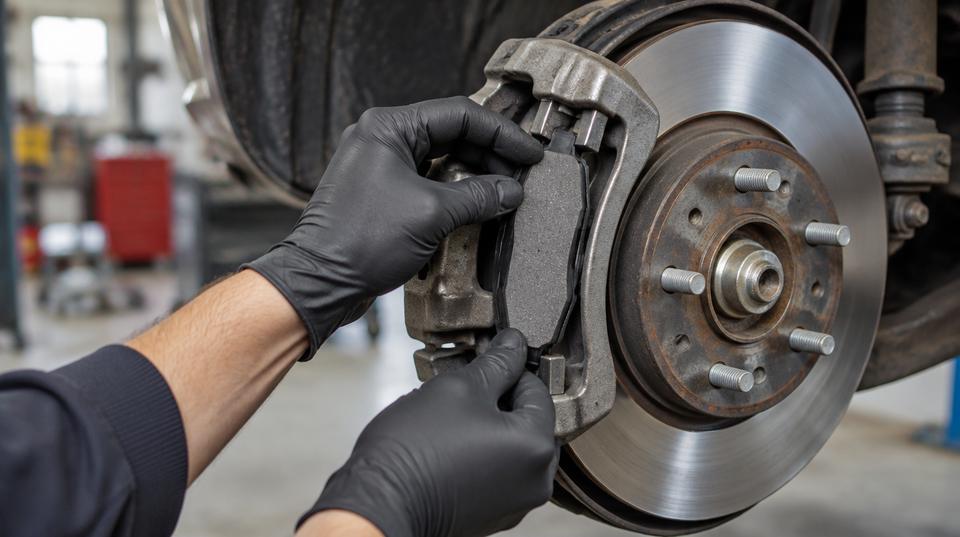
The mechanic takes the wheels off, measures how much pad is left and checks the discs against the maker's minimum thickness. They'll look at the calipers (the clamps that squeeze the pads onto the disc), the flexible brake hoses and the fluid.
Pads are always done in pairs across an axle, so both front wheels or both rear wheels get them together. Discs are replaced too if they're too thin, deeply scored or uneven. On some smaller cars the rear brakes are drums with shoes inside, which wear more slowly.
Brake fluid slowly absorbs moisture, which lowers the temperature it can take before it stops working well. The maker's schedule says how often it should be changed, so ask whether it's due. Hybrids and electric cars do a lot of their slowing with the motor, so their pads often last longer, but their calipers can still seize from lack of work.
Brakes and the WoF
Brake condition is on the list a WoF inspection checks, alongside tyres, steering and suspension. Thin pads, a leaking hose or a handbrake that won't hold the car can each end up on a fail sheet.
So if the brakes are already noisy and the sticker says the WoF is due soon, get the brakes sorted first. The inspection then has a better chance of being a formality.
What kind of garage suits a brake job?
Pads and discs are everyday work, so almost any general garage can do them, and many mobile mechanics fit pads on a driveway. Give the make and the model anyway, because brake parts differ even between versions of the same car.
Some brake work needs more gear. An ABS light, an electronic handbrake that has to be wound back with a scan tool, or a performance car with big multi-piston calipers is a job for a garage set up for that make. A local mechanic who specialises in your car.
What the written quote should list
- Front, rear or both, and whether it's pads only or pads and discs.
- The pad and disc thickness the mechanic measured, against the maker's minimum.
- Whether the brake fluid is being tested, changed, or left alone.
- Any caliper, hose or handbrake work as its own line, not folded into the pads.
- The parts being fitted: the maker's own, or another brand, named.
- A phone call before any extra work, with what it adds.
What you can check, and what to leave
You can
- Note when the noise happens: the first few stops of the morning, every stop, or only when turning.
- With the engine off, look at the brake fluid reservoir under the bonnet. The level shows through the side, so there's no need to open it.
- Check the ground where the car sleeps for drips. Brake fluid is usually yellow or clear.
- Look through the wheel spokes. Heavy dark dust on one wheel only can point to a brake that's dragging.
- Photograph any warning light on the dash for the mechanic.
Leave to the mechanic
- All brake work: pads, discs, hoses, calipers and bleeding the system. Don't do brakes yourself; one mistake and they don't stop the car.
- Topping up brake fluid. A falling level has a cause, and the mechanic should find it first.
- ABS faults and electronic handbrakes, which need a scan tool.
If it were our car
We'd treat a squeal as a job for next week and a grinding noise as a reason to park the car. Send the job with the make, the model and what the noise sounds like, and ask the mechanic to write the measured pad and disc thickness on the quote. Then you're deciding on numbers, not on a feeling.