Engine light flashing, or a red light on?
A flashing engine light often means a misfire bad enough to harm the exhaust's catalytic converter, and a red light means stop. Ease off, pull over somewhere safe and switch off, then look the light up in the owner's manual. Don't drive on with a red oil or temperature light. If you've stopped somewhere busy, everyone gets out on the side away from traffic, and call 111 if anyone is in danger.
What does a car scan actually read?
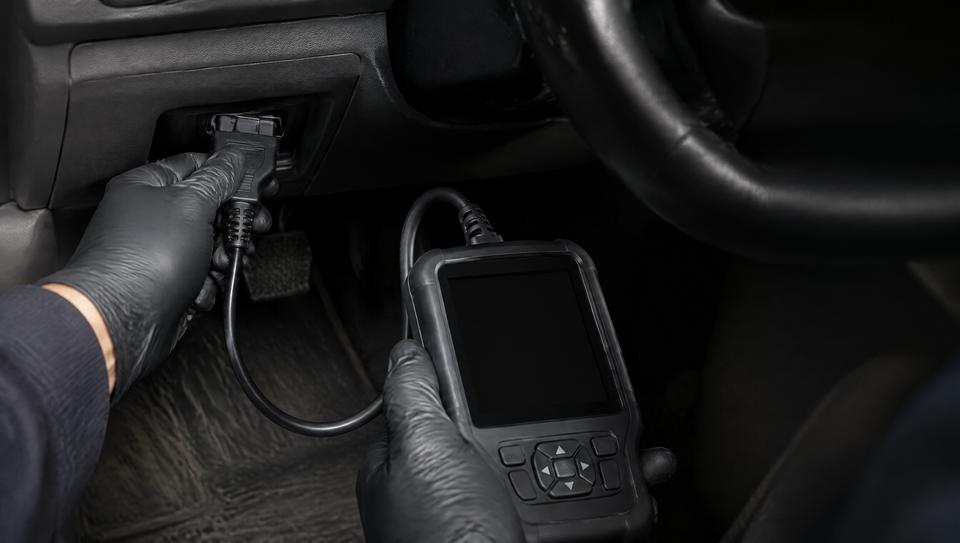
Cars have a diagnostic socket, a 16-pin plug within reach of the driver, usually under the dash. A scan tool connected there reads stored codes like P0301. The first letter gives the area: P for the engine and transmission, B for body, C for chassis, U for the network that links the car's computers. The rest of the code says whether it's a generic code or one the maker defined, and what was detected.
The rules only require emissions data on that socket, but most makers now use it for diagnosing and programming every system. European cars follow EOBD, Europe's version, on the same plug. A car first sold in Japan was built to JOBD, Japan's version of the standard, so with a Japanese import it's worth asking whether the garage's tool covers Japanese-market models.
Why isn't a code a diagnosis?
A code records what a sensor saw, not why. An oxygen sensor code can come from the sensor, its wiring, an air leak upstream or a fuel problem. Replacing the part named in the code's description, without testing, is how people end up paying for parts that didn't fix anything.
Clearing the code doesn't fix anything either: the fault is still there, and the light comes back. And sometimes the computer itself is the problem. AA New Zealand says electrical spikes, flat batteries, water leaks and corroded wiring can damage the engine computer, and even a poorly done jump start can send a damaging voltage surge through it.
A handheld reader next to a garage scan tool
| Handheld reader | Garage scan tool | |
|---|---|---|
| Engine codes | Yes | Yes |
| ABS, airbag, transmission and body codes | Rarely | Usually |
| Live sensor readings on a road test | Limited | Yes |
| Resets, coding and programming | No | Often, depending on the make |
| Which part has failed | No | No: that takes testing |
What a proper diagnosis looks like
Your account first
When the light came on, what the car was doing, and any recent work or jump starts. It narrows the search before a tool comes out.
Scan every module
The mechanic records the codes and the snapshot of conditions saved when each one was set, such as speed and engine temperature.
Test what the code points at
Wiring, connectors, sensor readings and pressures, until one cause explains the symptoms.
Repair, clear, road test
Codes get cleared after the repair, not before, and a drive confirms the light stays off.
Put it in writing
You get the codes, what was tested, what was found and what was done.
What the written quote or invoice should cover
- The codes found, written out.
- The tests done and what each one showed.
- The cause, in plain words.
- The repair and the parts, by name.
- Whether diagnosis time is charged on its own or rolled into the repair.
- Confirmation that the codes were cleared and the car road tested.
Warning lights and the WoF
Brakes and airbags, where fitted, are both on the WoF list, so a brake or airbag warning that stays on is worth having scanned before inspection day rather than after.
What you can do, and what's the mechanic's job
You can
- Photograph the dash with the light on, odometer in shot.
- Write down when it happens: cold, hot, uphill, at speed.
- Check the fuel cap clicks shut. On some cars a loose cap can set off the engine light.
- Check the oil level with the engine cold.
Leave to the mechanic
- Reading every module and the live data.
- Testing wiring, sensors and pressures.
- Clearing codes once the repair is done.
What we'd do
We'd ask for the codes in writing and for the testing behind the fix, not a part swapped on the strength of a code. If a light comes on and then goes out again, note when it happened, because that's half the diagnosis.