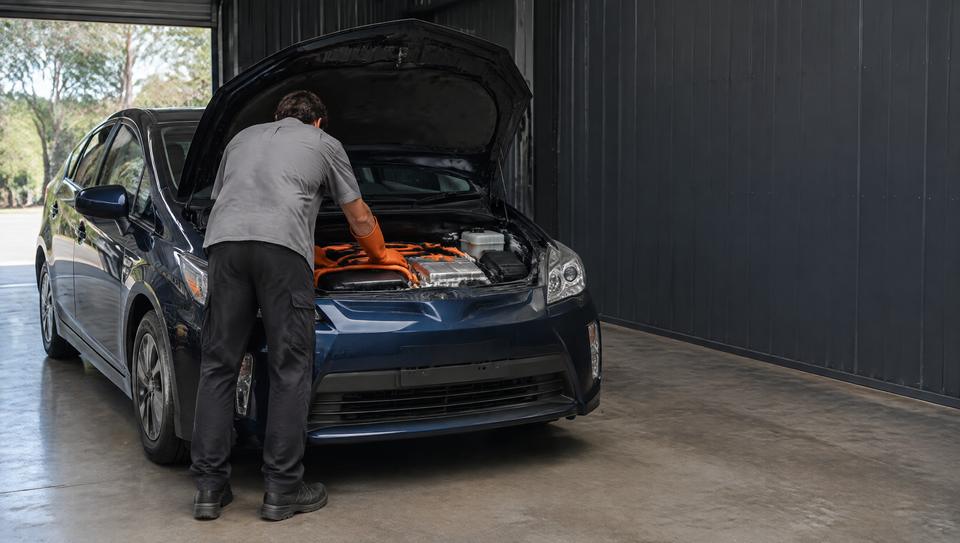
Smoke, a burning smell or a crash?
If a hybrid or EV smokes, smells of burning or has just been in a crash, pull over somewhere safe, switch off, and get everyone out and well away from the car. Leave the bonnet shut and don't touch damaged wiring. If there's fire or anyone is hurt, call 111.
Hybrid, plug-in or EV: what's actually different?
A full hybrid, like an Aqua or a Prius, can drive on the engine, the battery or both at once. A mild hybrid is mostly a normal petrol car with some hybrid hardware, and it generally can't run on electricity alone. A plug-in hybrid charges from the wall and can travel on battery power, but it still carries a petrol engine.
An EV has no engine at all. That removes the oil and spark plug side of a service, but AA New Zealand points out it still has a reduction drive (the gearing between motor and wheels) with its own oil, and the right grade matters.
What still needs a service on each
| Hybrid or plug-in | EV | |
|---|---|---|
| Engine oil, filters, spark plugs | Yes, on the maker's schedule | None: there's no engine |
| Brakes and brake fluid | Yes | Yes, even though the pads wear slowly |
| Tyres, steering, suspension | Yes | Yes |
| Battery cooling fan, filter or coolant | Where fitted, checked at services | Where fitted, checked at services |
| Cabin air filter | Yes | Yes |
Is the hybrid battery really the problem?
Toyota New Zealand says how long a pack lasts depends on how you drive, how often the car gets used, the model, and any long spells sitting still. Regular driving keeps the battery charged and inside a healthy voltage range, so a hybrid that's been parked up for months may simply need using.
The cooling side is the other suspect. Many hybrids cool the pack with a fan and a filter, and AA New Zealand says most owners don't know theirs is there. A clogged filter lets the pack run hot. Cleaning it is a small job; a new battery isn't.
There's also a separate small 12-volt battery in every hybrid. Toyota New Zealand says it's there to power the auxiliary electrics, so a tired one is a far smaller fix than the main pack.
What makes a hybrid battery replacement bigger or smaller?
The model sets most of it: how big the pack is, where it sits, and whether it's nickel metal hydride or lithium-ion. Then it depends on what else the test turns up, like a cooling fan that's failed, corroded connections, or a fault elsewhere in the hybrid system that would kill a new pack too.
Ask what happens to the old one. Toyota New Zealand says it retrieves nickel metal hydride hybrid packs and collects lithium-ion ones for future recycling, so a pack that comes out shouldn't end up in a skip.
What to ask before you agree to a new pack
- Did you test the pack itself, and can I see the result?
- Have you checked and cleaned the battery cooling fan and filter?
- Is the replacement new, used or reconditioned, and what warranty comes with it, in writing?
- Is any of the maker's warranty still running on this car's battery?
- Who will do the high-voltage work, and what training do they have for it?
- Where does the old battery go?
Hybrids, EVs and the WoF
A hybrid or EV goes through the same WoF as any other car: tyres, brakes, lights, steering and suspension and the rest of the list. The health of the high-voltage battery isn't on that list.
Brakes are the one to watch. Regenerative braking (the motor slowing the car and recharging the battery) does much of the stopping, so pads last longer, but friction brakes are still fitted and still have to pass. AA New Zealand also warns that brake fluid absorbs moisture and needs checking on an EV as much as on any car.
What's yours to do, and what isn't
You can
- Drive the car regularly rather than leaving it parked for weeks.
- Keep bags and blankets clear of any battery air vent your owner's manual shows inside the cabin.
- Check tyre pressures on a cold car.
- Photograph any hybrid or EV warning message before you switch off.
Leave to the mechanic
- Anything on the high-voltage side: the pack, its wiring and its connectors. Never open or touch them yourself.
- Testing the battery and cleaning the cooling fan and filter.
- Brake fluid, reduction-drive oil and battery coolant changes.
If it were our car
We'd get the pack tested and the cooling filter checked before anyone prices a new battery. If the pack really is finished, ask for the options side by side in writing, each with its warranty, and weigh them against the car's age and kilometres.