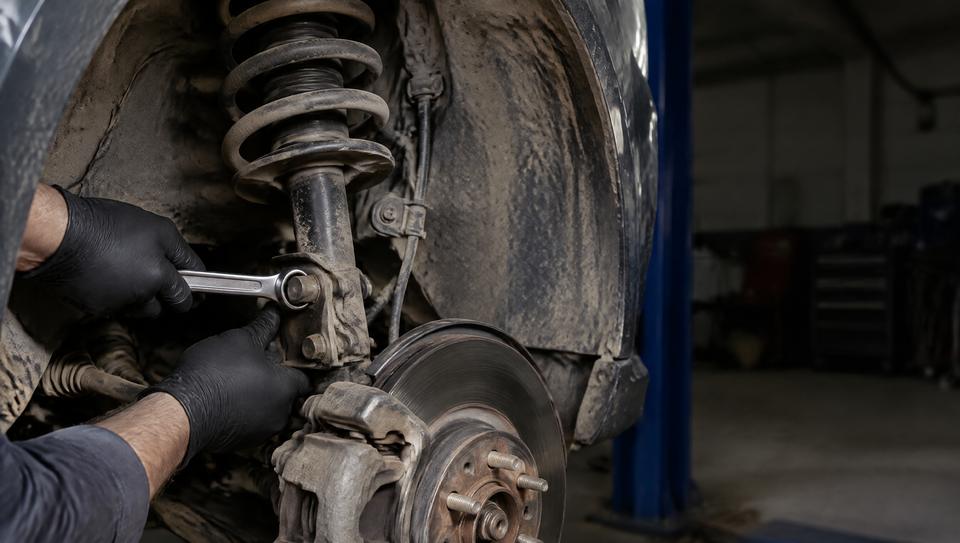
Steering feels loose or the car won't hold a line?
If the steering suddenly feels vague, the car darts about, or a wheel seems to wobble, slow down smoothly, pull over somewhere safe and switch off. Hazard lights on, and everyone waits off the road, away from the traffic side. Don't drive it to the garage; ring your roadside cover. If anyone is hurt or in danger, call 111.
What's actually down there?
The springs hold the car up, and the shock absorbers (dampers) stop it bouncing after a bump. Control arms, rubber bushes and ball joints locate each wheel. The steering rack and tie rod ends turn the wheels, and on front-wheel-drive cars the driveshafts have CV joints (constant velocity joints) that let them flex as you steer.
All of it wears with kilometres, potholes, speed bumps and gravel. Most of it wears slowly, which is why the change is easy to miss from behind the wheel.
What's that noise? A rough guide
| What it often is | How urgent | |
|---|---|---|
| Clunk or knock over bumps | Worn bushes, a sway bar link, a ball joint or a top mount | Soon. A ball joint is a safety part |
| Clicking on full lock, like in a car park | A worn CV joint on a driveshaft | Soon, before the joint lets go |
| A hum or drone that rises with speed | Often a wheel bearing | Soon; a bad bearing can overheat |
| Bouncing on after a dip | Tired shock absorbers | Within weeks; it lengthens stopping |
| Pulling one way on a straight road | Alignment, a tyre, or a dragging brake | Soon, and check tyre pressures first |
| Groaning when turning the wheel | Power steering fluid, a pump or the rack | Have it checked this week |
Worn suspension and your tyres
When a bush or joint wears, the wheel no longer sits at the angle it should, and the tyre starts scrubbing. You'll see it as wear on the inside or outside edge, or a scalloped pattern across the tread.
That matters for the WoF and for grip. Consumer Protection notes the legal minimum tread depth is 1.5 mm, and recommends more than 3 mm. So if a pair of tyres has worn unevenly, ask for the suspension and the wheel alignment to be checked before new tyres go on, or the new ones will go the same way.
Suspension, steering and the WoF
A WoF inspection checks steering and suspension, along with the tyres. Play in a ball joint or tie rod end, a split CV boot, or a shock absorber leaking oil can all appear on the fail sheet.
If the inspector has written it down, put that wording in the card's note. The mechanic who rings then knows exactly which part on which side, before they see the car.
What kind of garage suits the job?
Most general garages replace bushes, links, ball joints and shock absorbers, and many have their own alignment machine. If they don't, ask where the alignment will be done, because it should follow most steering and suspension work.
Lifted 4WDs, air suspension and some European cars with self-levelling systems need more specific knowledge and parts. Say so in the note. A local mechanic who specialises in your car.
What a good suspension quote spells out
- Which part, on which corner, and why it needs replacing.
- Shock absorbers and springs quoted in pairs across an axle.
- A wheel alignment after the work, with the before and after readings.
- The parts brand, and whether it's the maker's own or aftermarket.
- Anything else spotted on the hoist, listed separately for you to decide on.
What you can do, and what to leave
You can
- Check tyre pressures with the tyres cold. A soft tyre makes a car pull.
- Run a hand over the tread, or look closely, for wear on one edge.
- Notice when the noise happens: over bumps, turning, braking or at speed.
- Push down hard on each corner of the parked car. If it bounces more than once or twice, mention it.
Leave to the mechanic
- Checking joints and bushes for play, which needs the car on a hoist.
- Replacing any steering or suspension part. Springs hold a lot of force and can injure badly.
- Wheel alignment and power steering repairs.
Our take
We'd have a new clunk checked within a week or two, and anything that makes the steering feel loose checked before the car moves again. Put the noise and when it happens in the note, and ask for the alignment readings with the quote. Fix the cause first, then buy tyres.