Clutch gone in traffic?
If the pedal drops to the floor or you can't get it into gear, use the car's momentum to get off the road somewhere safe, then switch off. Hazard lights on, and everyone waits out of the car on the side away from traffic. Don't try to crunch it into gear and carry on. Ring roadside cover, and call 111 if anyone is hurt or in danger.
What does the clutch do?
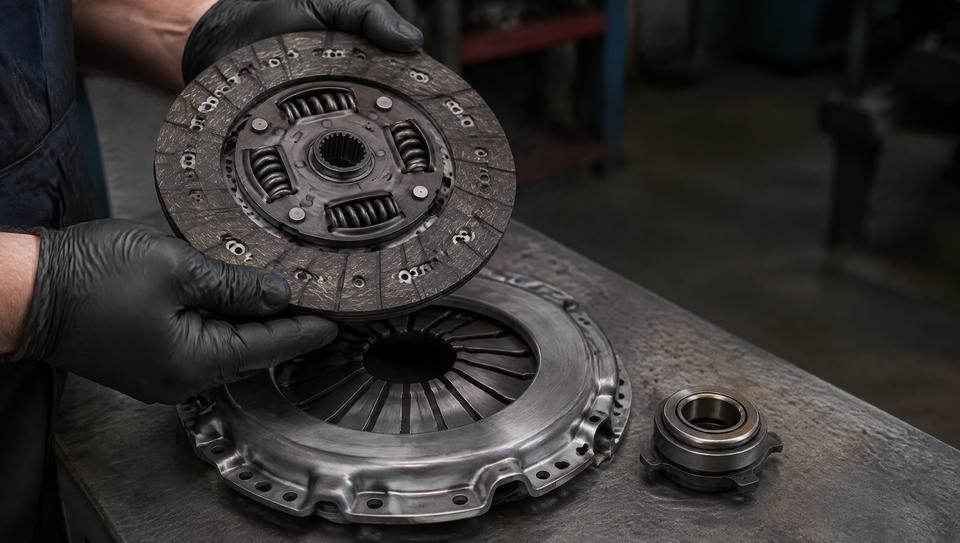
In a manual car, the clutch connects the engine to the gearbox and lets you disconnect it to change gear or stop. A friction plate is clamped against the flywheel by a spring-loaded pressure plate. Press the pedal and a release bearing frees the plate.
Most clutch pedals now work hydraulically, through a small master cylinder and a slave cylinder. AA New Zealand notes clutch fluid looks like brake fluid, usually yellow or clear, and a leak can stop the clutch working.
Signs the clutch is on its way out
- The revs flare without the car speeding up, worst uphill or in a high gear.
- A hot, burning smell after a hill start or a tow.
- The pedal bites near the top of its travel when it used to bite lower.
- A judder or shake as you pull away.
- A whirr or squeal that changes when you press the pedal.
- Gears that are hard to select, or a pedal that feels soft or sticks down.
What makes a clutch job bigger or smaller?
The gearbox has to come out, and how hard that is depends on the car. A small front-wheel-drive hatch is a different job from an all-wheel-drive wagon or a 4WD ute with a transfer case.
Many diesels and plenty of European cars have a dual-mass flywheel, a two-piece flywheel with springs inside that smooths out vibration. When it's worn it has to be replaced, not resurfaced, and it's the biggest single part of many clutch quotes. A single-piece flywheel can often be machined smooth and reused.
The hydraulics matter too. On a lot of cars the slave cylinder sits inside the bell housing, so replacing it with the clutch saves taking the gearbox out twice.
What kind of garage suits a clutch?
Most general garages replace clutches on everyday cars, and it's routine work for any garage that sees plenty of utes. Performance cars, all-wheel-drive models and anything with a dual-clutch automatic are better with a garage that knows the make. A local mechanic who specialises in your car.
A WoF won't flag a clutch that's wearing, so don't rely on a recent pass to tell you it's fine.
What the written clutch quote should list
- The clutch kit: friction plate, pressure plate and release bearing.
- The flywheel: reuse, machine or replace, and whether it's dual-mass.
- Slave cylinder and master cylinder, replaced or checked.
- A check of the rear engine seal and gearbox seals while it's apart.
- Gearbox oil, if it's being drained or topped up.
- A road test, and how long the garage needs the car.
What you can do, and what to leave
You can
- Test for slipping safely: in a high gear on a clear, gentle uphill, note whether the revs rise without the car speeding up.
- Look at the clutch reservoir under the bonnet through its side, and note if it's lower than the brake one.
- Rest your foot off the pedal while driving, and use the handbrake rather than the clutch to hold on hills.
- Tell the mechanic about towing, hill starts and stop-start driving.
Leave to the mechanic
- Removing the gearbox and fitting the clutch and flywheel.
- Bleeding the clutch hydraulics and replacing cylinders.
- Adjusting a cable clutch on older cars.
Our take
We'd get a slipping clutch quoted before it leaves us stranded on a hill. Ask for the flywheel and slave cylinder to be priced as separate lines, so you can see why two quotes differ. If the car is older, ask the mechanic plainly whether the car is worth the work.