Overheating, steam or thick white smoke?
Pull over somewhere safe and switch off. AA New Zealand's advice is to stop driving as soon as the engine overheats, because running hot can turn a gasket job into a warped or cracked head. Leave the coolant cap alone until the engine is completely cold. If you're on a busy road, everyone waits off the road on the side away from traffic, and call 111 if anyone is hurt.
What does the head gasket do?
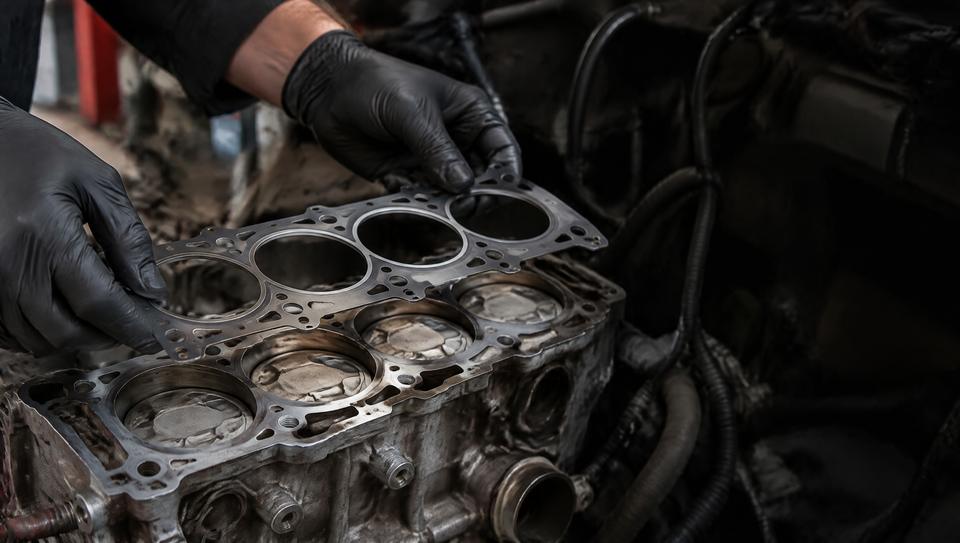
It's the seal between the engine block and the cylinder head bolted on top. It holds the combustion pressure inside each cylinder and keeps the coolant and oil passages, which run through both halves, apart from the cylinders and from each other.
AA New Zealand says overheating is the most common reason it fails, usually because of coolant loss, a blocked radiator or a thermostat that has stuck. That matters for the repair: a new gasket on an engine with the same cooling fault will go the same way.
Signs that point at the head gasket
- White exhaust smoke that keeps coming once the engine is warm, sometimes with a sweet smell.
- Coolant disappearing with no puddle or drip to show where.
- Bubbles or foam in the coolant reservoir with the engine running.
- Overheating, especially under load or on hills.
- Rough running or a loss of power.
- Creamy, milky residue under the oil filler cap or on the dipstick.
How a mechanic proves it
Rule out the simpler faults
An outside leak, a tired radiator, a stuck thermostat or a fan that won't switch on can all look like a gasket from the driver's seat.
Test the coolant for exhaust gas
A chemical test over the reservoir changes colour if combustion gas is getting into the cooling system.
Check each cylinder's pressure
A compression test compares the cylinders, and one that's down stands out, though it can't say where the pressure is going.
Find where it's leaking
A leak-down test does that part: air goes into the cylinder, and bubbles rising in the coolant point to the gasket rather than the rings or valves.
Read the oil with care
Milky residue under the cap can mean coolant in the oil, but on a car that only does short trips it's often condensation, so it's a clue, not proof.
What the repair involves, and what makes it bigger
The gasket itself is usually an inexpensive part. The work is in removing the head: draining the coolant, disconnecting everything attached to it, and, on many engines, taking the cambelt or chain off first. The head then goes to be checked for cracks and machined flat if it has warped, before it goes back on with a new gasket set and, often, new head bolts.
The job grows on engines with two cylinder heads, when the head is cracked rather than just warped, or when overheating has hurt other parts. It's smaller when the fault is caught early and the head is still straight. Because so much is hidden until the head is off, you'll usually get an estimate first rather than a fixed quote.
What the written estimate should cover
- Which tests confirmed the gasket, and their results.
- Checking the head for cracks, and machining it if needed.
- The gasket set and head bolts.
- The cambelt and its parts, if they're coming off anyway.
- Fresh coolant, oil and an oil filter.
- The fix for whatever caused the overheat: radiator, thermostat, fan or hose.
- How they'll contact you if something else turns up once the head is off.
Repair it, or let the car go?
Set the written estimate against what the car will be worth with a healthy engine, and against the state of everything else on it. Consumer Protection suggests a second opinion from another garage if you're unsure a part needs replacing, and on a job this size that's sensible.
The WoF won't help you decide: the head gasket isn't one of the items an inspector checks, so a recent pass says nothing about it.
What you can do, and what's the mechanic's job
You can
- Check the coolant reservoir each morning, engine cold, and note how fast the level drops.
- Look under the oil filler cap for creamy residue and mention it.
- Note when the gauge climbs: in traffic, on hills, or all the time.
- Tell the mechanic if any sealer or additive has gone into the cooling system.
Leave to the mechanic
- Exhaust gas, compression and leak-down tests.
- Removing, checking and machining the cylinder head.
- Finding and fixing the cooling fault that caused it.
Our take
We'd want the gasket proven by a test before agreeing to anything, with the cause of the overheat found and priced in the same written estimate. On an older car, weigh that estimate against what the car is worth, and get a second opinion if it's close.