Mobile mechanic or garage?
| Mobile mechanic | Garage | |
|---|---|---|
| Where the work happens | Your driveway, a work car park or the kerb | The garage's own premises |
| Good for | Batteries, services, brake pads, starting faults, sensors, inspections | Clutches, gearboxes, exhausts, big suspension jobs, alignments |
| Lifting the car | Jacks and stands, so some jobs are limited | A hoist, so the whole underside is reachable |
| The WoF | Can sort small items beforehand, like bulbs and wipers | Ask whether they do WoF inspections |
| Your time | No drop-off or pick-up | You get the car there, or arrange it |
What can a mobile mechanic do at my place?
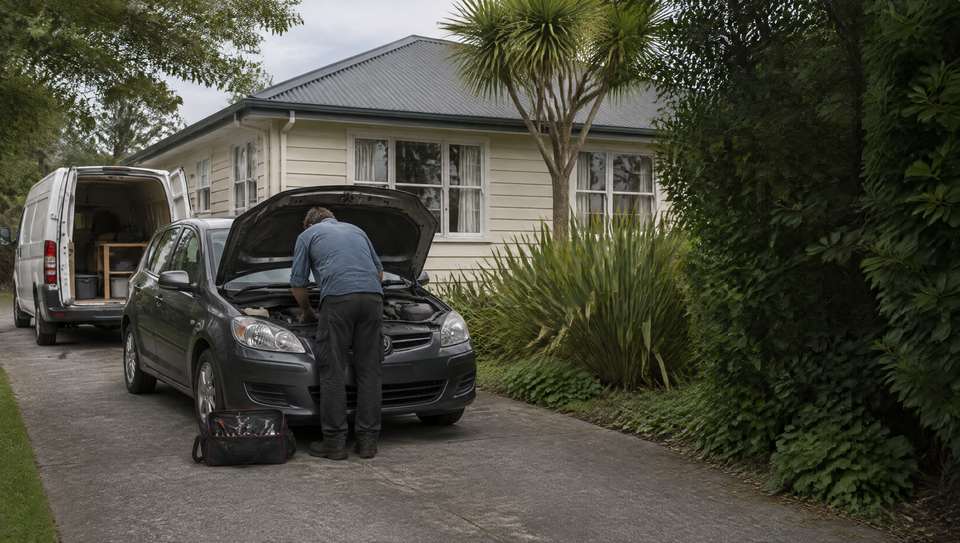
More than most people expect. A van carries a scan tool, a battery tester, hand and power tools, and the common service parts, so a standard service, a new battery, brake pads and discs, a starter motor or a faulty sensor can all be done on a driveway.
They're also handy when the car won't start, because it doesn't have to be towed anywhere to be looked at. And for a pre-purchase inspection, meeting the car where the seller keeps it saves everyone a trip.
When the car still needs a garage
Jobs that need the car high in the air or a heavy part lowered out of it belong in a garage. That covers clutches and gearboxes, most exhaust work, major suspension work and wheel alignments.
A WoF is also its own thing. Inspections are done by a vehicle inspector working for an inspecting organisation, and in practice that means a garage or a testing station. A mobile mechanic can still help before the day, or sort small items from a fail sheet.
Is it the same as roadside assistance?
Not quite. Roadside cover is there to get you moving or tow you when you've broken down, often on the road itself. A mobile mechanic usually comes by arrangement, to a car parked somewhere safe, and does the repair.
If you're stopped on a busy road or the motorway, ring your roadside cover rather than waiting for anyone to work beside traffic. Everyone stays out of the car, away from the traffic side, and if anyone is hurt or in danger, call 111.
Same rights, van or workshop
New Zealand has no mechanic licence, so there's nothing to look up either way. What matters is the business behind the van.
The Consumer Guarantees Act applies just the same in a car park as in a workshop: reasonable care and skill, fit for the purpose you asked for, and done in a reasonable time.
Questions to ask a mobile mechanic
- Can this job be done where the car is parked, or will it need a hoist?
- Will you bring the parts, matched to my make and model?
- What happens if you find something bigger once you start?
- Will you take away the old oil, filter or battery?
- Can I have the quote and the invoice in writing?
- What warranty do you give on your work?
How to get ready, and what to leave
You can
- Park on flat, firm ground, off the road, with room to open the bonnet and doors.
- Check that your workplace, landlord or body corporate is fine with the work.
- Have the keys, the locking wheel nut key if there is one, and the service book ready.
- Tell the mechanic about anything unusual, like a car that sits for weeks or a recent warning light.
Leave to the mechanic
- Jacking and supporting the car safely, and deciding whether a job can be done on site.
- The repair, and taking away the waste properly.
- Telling you honestly when the job needs a garage instead.
What we'd do
We'd pick the mobile option for a battery, a service or a car that won't start, and give the exact spot where the car is parked in the note. Ask on the call whether the job can be finished there. If it can't, it's no loss to have a mechanic who's seen the car arrange the next step.