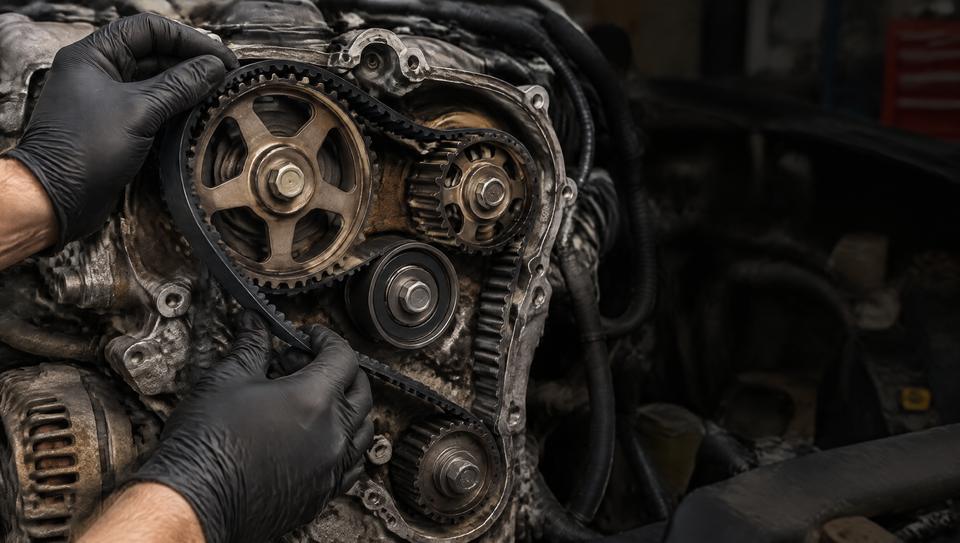
Engine died on the move and won't fire again?
A snapped cambelt is one possible cause. Coast off the road somewhere safe, hazard lights on, and stop trying to start it, because cranking an engine with no timing can add to the damage. Everyone waits well off the road on the side away from traffic. Ring your roadside cover for a tow, and call 111 if anyone is in danger.
What does a cambelt actually do?
It links the crankshaft (turned by the pistons) to the camshaft (which opens the valves), so every valve opens and closes at exactly the right moment.
The rubber ages with heat and kilometres. Oil leaking onto it softens the rubber, and coolant can damage the cords inside, so a belt on a hot or leaky engine wears out sooner. When it goes, it usually strips teeth or comes apart from the inside, and a worn belt gives no sign it's about to fail. That's why it's changed on a schedule rather than when it looks tired.
When is it due, and how do you find out?
The owner's manual or service schedule gives two limits, kilometres and years, and the belt is due at whichever comes first. A car that does few kilometres still needs it on age.
Then look for proof it's been done: an invoice that names the cambelt, or a service book entry with the date and odometer reading. A Japanese import or a private sale may come with no paperwork at all. If there's no record, we'd treat the belt as due. A mechanic can see part of the belt through its cover, but a belt that looks fine can still let go.
What happens if it snaps?
That depends on the engine. In an interference engine the open valves reach into the space the pistons move through, so once the timing is lost the pistons hit the valves and usually bend them. If only the valves are bent, new valves and timing parts may fix it. If the pistons or cylinders are damaged too, it's an engine rebuild or a replacement engine.
Before anyone quotes that work, a mechanic checks for bent valves with a leak-down test or by measuring the valve gaps. On engines designed so the valves and pistons can't meet, a snapped belt is usually a tow and a new belt.
Cambelt or chain?
| Cambelt | Timing chain | |
|---|---|---|
| Made of | Toothed rubber | Metal links |
| Replaced | On the maker's schedule | No routine interval |
| Warning before it fails | Usually none | Often a rattle from the front of the engine as it wears |
| What shortens its life | Heat, oil leaks, coolant leaks | Poor lubrication, a failed tensioner or guide |
What the written quote should spell out
- The belt, the tensioner and the idler pulleys, which are often sold together as a kit.
- Whether the water pump is driven by the belt on your engine, and whether it's being replaced.
- Any leaking oil seals near the belt, since oil shortens the new belt's life.
- The drive belt for the alternator and air conditioning, if it has to come off anyway.
- Fresh coolant if the water pump is changed.
- The date and kilometres written on the invoice and in the service book.
Does the WoF check the cambelt?
No. The WoF looks at safety items such as tyres, brakes, lights, steering and the exhaust, not engine wear. Consumer Protection makes the same point from the buyer's side: a current WoF doesn't mean a car is in good mechanical condition.
So if you're buying a car with a belt-driven engine, ask for proof of the last cambelt change, or have it checked in a pre-purchase inspection.
What you can check, and what to leave
You can
- Find the schedule in the owner's manual or service book and write down both limits.
- Hunt out invoices that name the cambelt.
- Note any oil or coolant leak at the front of the engine.
- If you've just bought the car with no record, say so in the note.
Leave to the mechanic
- Confirming belt or chain on your exact engine.
- Replacing the belt and the parts around it, and setting the timing.
- Testing for valve damage if a belt has already failed.
Where we'd start
We'd look up the schedule and the last change before anything else. If the engine has a belt and nobody can prove when it was done, we'd treat it as due now and ask for the belt, tensioner, idlers and water pump in one written quote.