Strong smell of fuel in or around the car?
Treat it as a fire risk. Pull over somewhere safe, switch off and get everyone out, with no smoking or flames anywhere near. Don't restart the engine to see if it's still there. Ring your roadside cover, and call 111 if fuel is pouring out or there's any sign of fire.
What does an injector do?
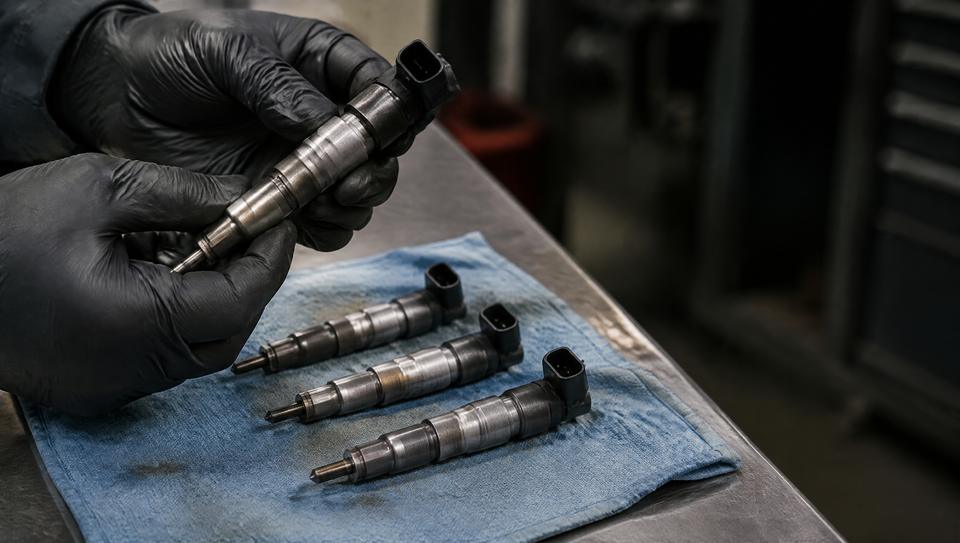
It's a precise electric spray nozzle that opens and closes many times a second, metering fuel into the engine. The engine computer decides when each one fires and for how long.
Where the fuel goes depends on the engine. Port injection sprays into the intake port, just before the intake valve. Direct injection sprays straight into the cylinder, so only air passes the valves. Diesels use direct injection too, usually common rail: one shared rail holding fuel at very high pressure, feeding every injector.
Which injection does your engine have?
| Petrol port injection | Petrol direct injection | Diesel common rail | |
|---|---|---|---|
| Where the fuel goes | Into the intake port | Straight into the cylinder | Straight into the cylinder, from a high-pressure rail |
| Usual trouble | Deposits on the nozzle | Injector wear, plus carbon on the intake valves | Worn or leaking injectors, dirty or wet fuel |
| Does cleaning help? | Often, if deposits are the cause | For the injectors sometimes, never for valve carbon | Sometimes: testing decides |
Why do direct injection engines build up carbon?
On a port-injected engine, petrol washes over the back of the intake valves every time it sprays, which keeps them fairly clean. Direct injection skips that washing, so carbon deposits can build up on the valves over time. Some makers fit a second set of injectors in the intake partly to help keep that carbon away.
Injector cleaning doesn't touch those valves. If a direct injection petrol engine runs rough, ask the mechanic whether intake carbon is part of it before anyone replaces injectors.
Signs an injector needs a look
- A rough or uneven idle.
- Stumbling or hesitation when you accelerate.
- Fuel use creeping up for no obvious reason.
- Hard starting, especially when the engine is warm.
- An engine light, or one that flashes under load.
- On a diesel: more smoke than usual, or a louder knock.
How a mechanic tests them, and what comes next
The scan comes first: misfire codes often name a cylinder, and live data shows how hard the computer is correcting the fuel mixture. Then each injector gets tested, electrically and for how much fuel it delivers. On a diesel that usually means a leak-off test, which shows how much fuel each injector lets back instead of spraying, plus a rail pressure check.
From the results there are three paths. Mild deposits can be cleaned. Injectors that come out can be ultrasonically cleaned, fitted with new seals and filters, and flow-tested before and after. A worn or electrically failed injector gets replaced, and on many diesels the new one has to be coded to the engine computer.
What a good written quote lists
- The test result for each injector, not just a symptom.
- The cleaning method: on the car, or off it with flow testing.
- New seals and washers for every injector that comes out.
- For diesels: new or reconditioned injectors, and coding if needed.
- A new fuel filter, if one's due.
- Any intake valve carbon cleaning, listed as its own item.
Injectors and the WoF
The inspector looks over the fuel system, so a weeping injector seal or a fuel smell under the bonnet is worth fixing before the WoF rather than after.
What you can do, and what to leave alone
You can
- Use the fuel grade the owner's manual or fuel flap specifies.
- Keep diesel fuel filter changes on the maker's schedule.
- Note exactly when the stumble happens: cold, warm, at idle or under load.
- If you smell fuel, note where it seems strongest and tell the mechanic.
Leave to the mechanic
- Any work on fuel lines, which can hold fuel at very high pressure on a diesel. Never loosen them yourself.
- Injector testing, removal, cleaning and coding.
- Intake valve carbon cleaning.
Where we'd start
We'd ask for a test before a clean, and a clean before a replacement, unless the test shows an injector has failed outright. On a direct injection petrol engine, we'd also ask whether valve carbon is part of the problem, because new injectors won't fix that.