Exhaust fumes inside the car?
Fumes in the cabin can contain carbon monoxide, which makes people drowsy and can't always be smelled. Open the windows, pull over somewhere safe, switch off and get everyone out into fresh air. Don't drive on until the leak is found. If anyone feels dizzy, faint or sick, call 111.
What's in an exhaust system?
The exhaust runs from the engine to the tailpipe. Along the way, the catalytic converter turns the worst gases into less harmful ones, and the muffler (silencer) takes the edge off the noise. Most modern diesels, and some newer petrol cars, also carry a particulate filter that traps soot.
Sensors along the system report to the engine computer. When one of them sees something wrong, you get the engine light, sometimes before you notice anything else.
Signs the exhaust needs a look
- It's suddenly louder, or roars when you accelerate.
- A rattle or a metallic buzz from under the car, worst at idle.
- A rotten-egg smell, which can point to the catalytic converter.
- The engine light, or a DPF light on a diesel.
- Less power than usual, or the car going into limp mode.
- Black soot around the tailpipe of a diesel that used to run clean.
Catalytic converter problems
Converters don't often wear out by themselves. They usually fail because something upstream is wrong: an engine misfire sends unburnt fuel into the converter and overheats it, or burning oil coats it. Then the inside can break up and rattle, or block and choke the engine.
So the first question to ask is why it failed. A new converter fitted without fixing the misfire can go the same way. Ask for a replacement that's right for that car and engine, not just one that fits the pipe.
Why diesel DPFs block
A DPF fills with soot as the engine runs, then cleans itself by burning it off when the exhaust gets hot enough. That's called regeneration. Short trips around town rarely get it hot enough, so the soot builds up until the light comes on.
A mechanic can trigger a regeneration with a scan tool, clean the filter, or in the worst cases replace it. A good one also looks for the reason it blocked: injectors, sensors, the EGR valve (which feeds some exhaust back into the engine) or the wrong oil can all add to the soot.
DPF light on? What to do
Check the manual
It says what that light means for your car, and whether a steady drive at speed is the maker's way to clear it.
If the manual says so, give it a proper run
Only on a road where you can hold a steady speed safely and legally. Revving the engine while parked isn't the same thing.
If the light stays on, flashes or power drops
Stop relying on runs to clear it and have it checked. A filter that keeps blocking has a cause.
Say diesel and DPF in the note
So the mechanic who rings has the scan tool and knows the engine.
Taking the filter or converter out isn't a fix
Now and then someone suggests removing a DPF or a catalytic converter instead of fixing it. We wouldn't. These parts are how the car keeps its emissions in check, the exhaust is on the WoF list, and an empty can doesn't solve whatever caused the blockage.
If anyone offers it, ask them to put in writing how the car would still pass its WoF. A garage that does exhaust work properly will steer you towards finding the cause instead.
What the written quote should cover
- What failed, and what caused it: a misfire, a sensor, short trips, or age.
- For a DPF: whether it's a regeneration, a clean or a replacement, and why.
- Any part being replaced, and whether it's the maker's own or another brand.
- Brackets, rubber hangers, gaskets and clamps, listed rather than lumped in.
- Fault codes before and after, and a test drive to confirm.
What you can do, and what to leave
You can
- Note when the noise or smell happens, and photograph any warning light.
- Look at the tailpipe for soot or drips, with the engine off and the pipe cold.
- On a diesel, read the manual's section on the DPF light and follow it.
- Mention lots of short trips in the note. It helps explain a blocked filter.
Leave to the mechanic
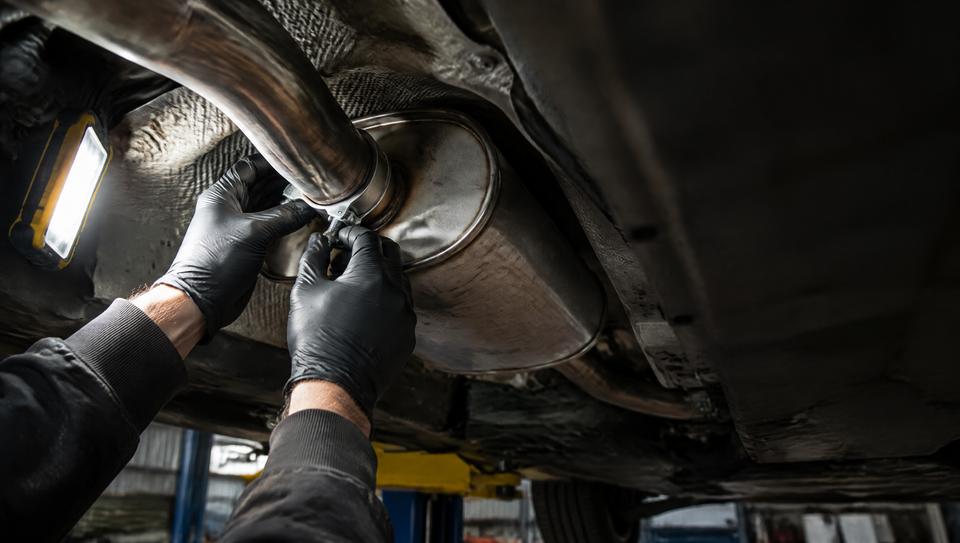
- Anything under the car: the pipes get hot enough to burn, and the car needs a hoist.
- Forced regeneration and fault codes, which need a scan tool.
- Converter and DPF replacement, and finding why they failed.
Where we'd start
We'd treat any fumes in the cabin as a reason to stop driving, and a new noise as a job for this week. For a DPF light, follow the manual once, and if it comes back, have the cause found rather than paying for clean after clean. Say petrol or diesel in the note so the right garage rings.