Heavy smoke, or the engine revving by itself?
Pull over somewhere safe and switch off. A turbo with failed seals can push oil into the exhaust, and on a diesel that oil can feed the engine so it revs on its own. If the engine won't stop when you switch off, or you see flames, get everyone out and well away and call 111. Otherwise leave it parked until it's been checked.
What does a turbo do?
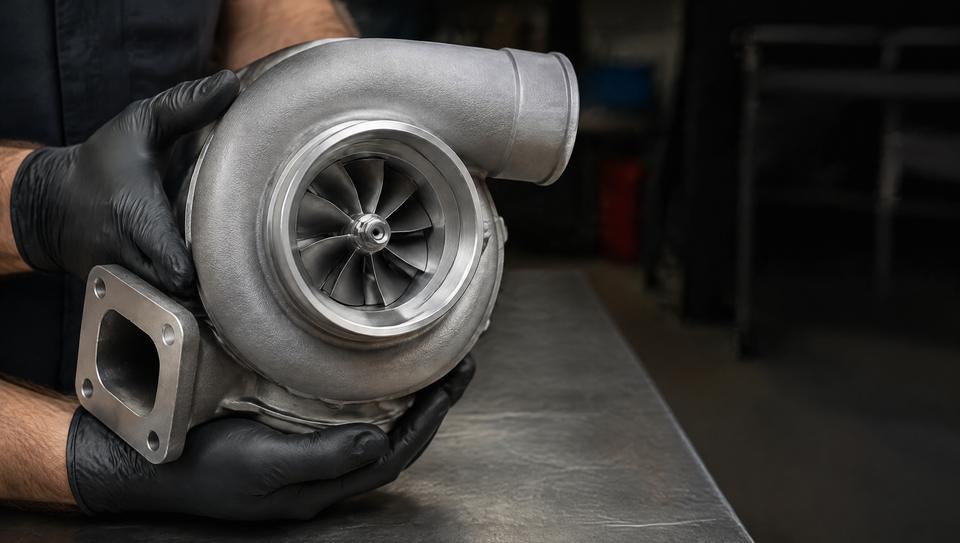
It uses the engine's own exhaust to pack more air into the cylinders. Exhaust gas spins a turbine, which turns a compressor on the same shaft, and that shaft can spin at up to 250,000 rpm. A wastegate stops too much exhaust reaching the turbine, and an intercooler cools the air after it's been squeezed. The short pause before the boost arrives is turbo lag.
Many diesels use a variable-geometry turbo, with movable vanes inside the housing that cut lag at low revs. Those vanes and the actuator that moves them can stick, and that alone can make a healthy turbo feel like it's failed.
Signs the turbo wants a look
- A whine or siren noise that's new or getting louder.
- Blue-grey smoke from the exhaust, worst when you accelerate.
- Power that's down, or boost that builds slowly.
- An engine light, or the car dropping into a reduced-power mode.
- Oil inside the intercooler pipes.
- The oil level falling faster than it used to.
Is it actually the turbo?
Plenty of boost problems happen elsewhere. A split hose or loose clamp leaks boost before it reaches the engine. A wastegate or vane actuator can stick. A boost sensor can read wrong. A blocked air filter or particulate filter can choke the whole system. Even blue smoke can come from engine wear rather than the turbo's seals.
So a good mechanic checks the boost pressure on the scan tool's live data, smoke-tests the intake for leaks, and feels for play in the turbo's shaft before calling it.
Why do turbos fail?
Engine Professional, the engine builders' magazine, lists the usual causes as dirty oil, too little oil, debris getting into the air intake, too much heat or friction, switching off straight after hard running, and spinning parts touching inside the housing.
Most of those come back to oil and air. The turbo's bearings live on engine oil, so late oil changes, the wrong grade or a blocked oil feed line wear it out early. That's why the cause has to be found and fixed, or the new turbo inherits it.
Fix the fault, rebuild, or replace?
| When it fits | What to ask | |
|---|---|---|
| Fix a hose, clamp, sensor or actuator | The turbo spins freely, its seals are dry, and boost is being lost elsewhere | What test found it? |
| Rebuild the turbo | The housings are sound and the wear is inside | Who rebuilds it, and what warranty comes with it? |
| Reconditioned or new turbo | The housing or shaft is damaged, or a rebuild isn't offered for that model | Is it the right part for the engine, and what does the warranty need from you? |
What the written quote should cover
- The cause, in writing, and the test that found it.
- An oil and filter change, so the new turbo starts on clean oil.
- New or cleaned oil feed and return lines.
- Cleaning oil and debris out of the intercooler and its pipes.
- A new air filter, and new gaskets for every joint disturbed.
- Setting up an electronic actuator, if the turbo has one.
Turbos and the WoF
The turbo itself isn't inspected, but the exhaust is on the WoF list, so oil smoke or an exhaust leak around a failing turbo is better sorted before the inspection.
Your part, and the mechanic's
You can
- Change the oil on time, with the grade and specification the handbook lists.
- Check the oil level regularly with the engine cold.
- Replace the air filter on schedule.
- After towing or a hard climb, give the engine a short idle before switching off if the handbook suggests it.
Leave to the mechanic
- Boost testing and smoke-testing the intake.
- Removing and fitting the turbo.
- Finding the reason it failed.
What we'd ask for
We'd want to know why the turbo failed before paying for another. Ask for the cause in writing, and make sure the quote includes fresh oil, a clean intercooler and new oil lines, because a new turbo fed dirty oil goes the same way as the old one.